The Story
WS Ranch wears its founder's initials. The land was originally homesteaded by Wan Shields in the early 1900s, one of the original homesteads in Bridgeland, a small farming community in Duchesne County in Utah's Uinta Basin, and the WS brand honors him. In the 1960s the ranch passed to his son, Gary Shields, and Gary's wife Thelma, who raised their four children there while keeping the family's ranching going. The operation describes itself today as a third-generation ranch and a longtime staple of its community.
For most of that history this was a conventional ranching family, cultivating the land and raising Angus cattle to industry standards. The newer chapter is the direct-to-consumer one: rather than sending animals into the commodity stream, the family now dry-ages its own beef and sells it straight to the people who eat it, both online and over a retail counter. The shift is the same one that recurs across this directory, a long-established ranch deciding to capture the value, and the relationship, that the commodity system strips out.
The brand has a split personality worth noting, in a good way. It operates as WS Ranch and also under the name Basin Beef, a nod to the Uinta Basin it calls home, and it has built out an unusually active social presence across several platforms. The storefront sells more than beef: eggs, a line of seasonings and sauces, even skincare, which is why the web domain is farmhouse-products.com rather than the ranch name. It is a small ranch behaving like a modern brand.
The family frames the whole thing around transparency and a direct connection to the source, and invites questions about its practices. For a third-generation Basin homestead, the move from anonymous cattle sales to a named, dry-aged, counter-and-online beef business is a meaningful bet on doing the work, and the marketing, themselves.
The Practices
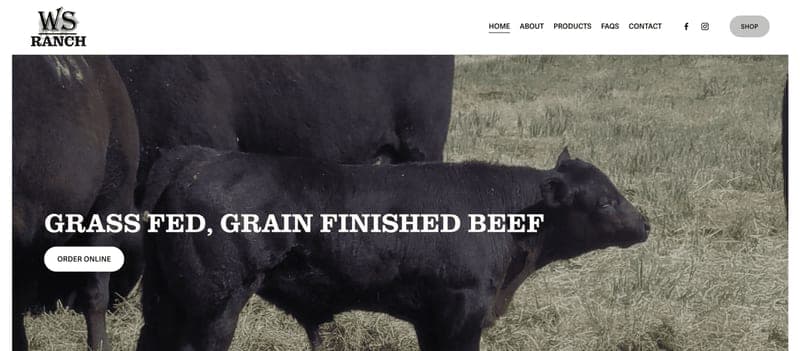
WS Ranch is unusually clear about its finish, stating plainly that its beef is grass-and-grain-finished, raised for what the family calls the perfect balance of marbling and depth of taste. This puts it cleanly on the grain-finished side of the honest fork, and the ranch does not dress it up as anything else. The cattle are Angus, raised on open pastures the family describes as rich in native grasses and wild herbal forage, and finished on grain for marbling before harvest.
The signature practice is dry-aging. The beef is dry-aged 14 to 21 days for concentrated flavor and tenderness, handled through a local processor the family says shares its practices. Dry-aging at this scale, on a small ranch's own product, is comparatively rare and is the quality lever the brand leans on hardest in its marketing, pitching to chefs and small markets as well as home cooks.
Beyond beef, the ranch rounds out its storefront with farm-fresh eggs and locally sourced pork, the latter a York/Duroc cross bought from another Utah farmer rather than raised on the ranch, a sourcing detail the site discloses. The family characterizes its cattle as ethically and sustainably raised and makes transparency a stated value, explicitly welcoming questions about how the animals are handled. We haven't stood in the pasture and watched, but WS Ranch names its finish honestly, discloses which products it raises versus sources, and operates a physical storefront where buyers can see the product, all of which make it easy to take at its word.
WS Ranch lists dry-aged, grass-fed, grass-finished, no hormones, and pasture-raised on their public-facing materials. These are the producer’s own claims; we do not independently audit them. Available locally in Utah.